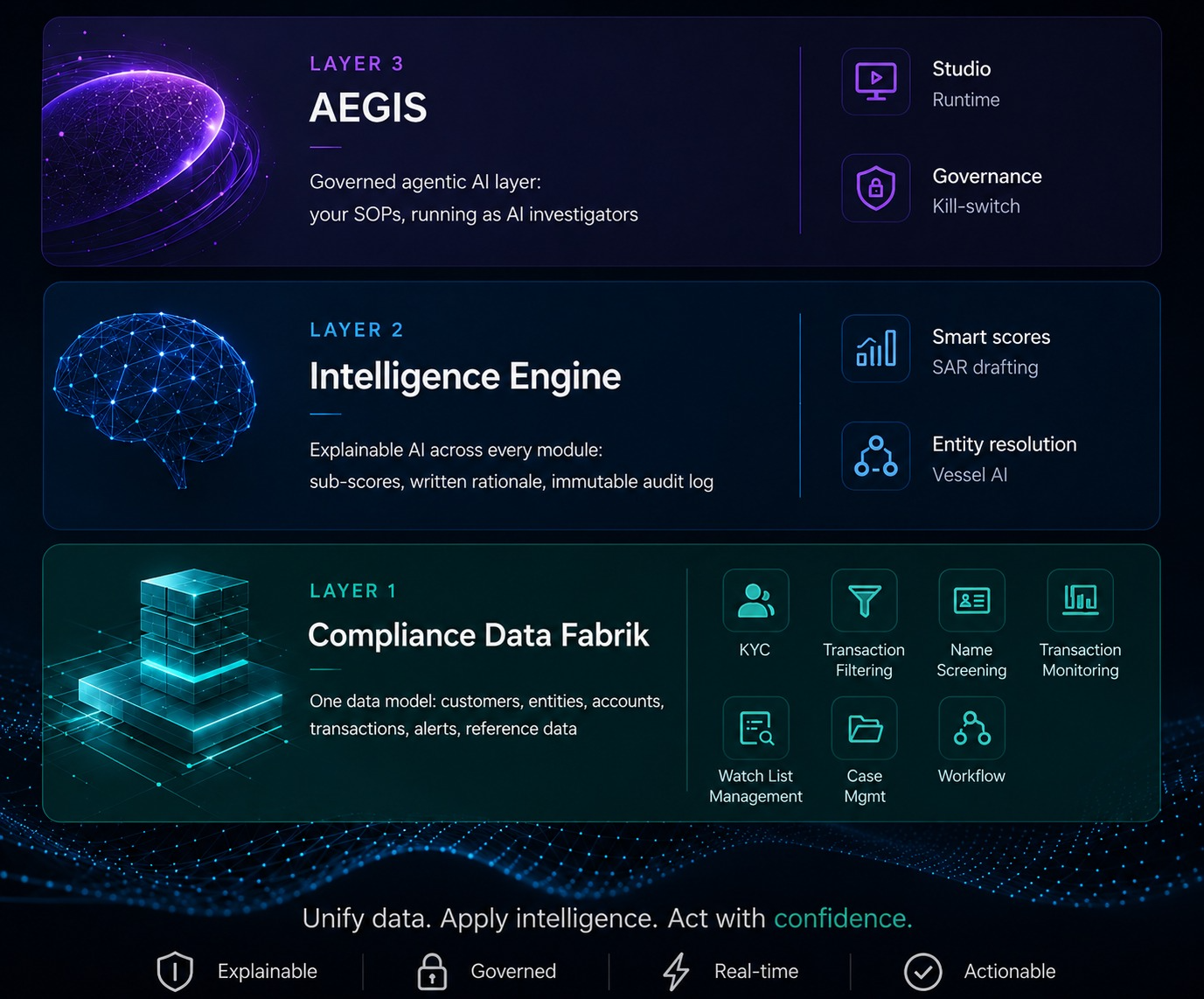
Three layers, one connected data model: how FabriK unifies KYC, screening, monitoring and list management, and adds governed AI agents with a full audit trail.
Compliance teams are drowning in false positives produced by disconnected tools, while regulators demand explainable AI. FabriK connects KYC, screening, transaction monitoring, watch list management and case management into a single intelligent system on one connected data model. It explains every decision it makes, and it progressively automates the work that does not need human judgement while keeping humans in control of the work that does.
Everything in FabriK sits on a single data model: one customer record, one case record, with customers, entities, accounts, transactions, alerts and reference data unified in one place. When any module raises an alert, the full context is already attached. No analyst plays archaeologist across five systems.
Explainable AI in every module. FabriK's intelligence layer is a hybrid of deterministic logic and generative AI: rules handle the clear-cut cases, AI adds judgement where ambiguity, context and pattern recognition earn their keep. Every decision decomposes into sub-scores, each with a written rationale, stored in an immutable audit log.
Alert re-scoring that suppresses false positives with a written reason for every suppression
AI entity resolution on borderline name, date of birth and address matches
Adverse media classification tuned to financial crime relevance
SAR narratives drafted from structured case data in your house style
Plain-English explanations whenever a risk score changes
Regulatory change monitoring mapped against your own control framework
Natural-language scenario builder: describe the behaviour, get a deployable monitoring rule
Vessel and sanctions intelligence combining live AIS, ownership and behavioural signals
The design principle throughout: explainable by design. A regulator, an auditor or an MLRO can follow every outcome from input to conclusion.
AEGIS is what makes FabriK different in kind, not just degree. A governed agentic layer where your compliance team builds, tests and deploys its own AI investigators using your own standard operating procedures as the agent definition. Maker-checker approval. Human decision on every case. Kill-switch always on.
The best way to understand FabriK is to watch it work. Here is a potential sanctions match on a payment, end to end.
A payment triggers a potential sanctions match. Transaction Filtering screens it in real time, before execution.
The Intelligence Engine scores the match likelihood, decomposed into sub-scores with a written rationale for each factor.
Because everything shares one data model, the full picture attaches automatically: KYC profile, risk rating, screening history, related accounts, prior cases. No analyst archaeology.
An AEGIS sanctions agent investigates according to your own SOP: it analyses the match, checks ownership linkages and country risk, and assembles evidence with citations and a confidence score.
The agent routes its recommendation to a human. The human decides; the agent documents; nothing closes without a person.
The audit log has captured every step. A false positive dies in seconds with a written rationale. A true risk arrives investigated, not raw.
Every module runs standalone as well as together, because they all sit on the same data model and Integration Hub. Land on the pain point. Expand on the platform, if and when you choose to.
Takes Transaction Filtering alone. Real-time screening at execution. Expands to monitoring later when ready.
Takes Watch List Management alone. Direct-source updates, vessel intelligence. No rip and replace of anything.
Takes AEGIS over the systems they already run, replacing nothing. Proves governed AI on the worst backlog first.
A human approval step is mandatory before close or escalate. This is not a setting; it is how the system is built.
A second approver is mandatory before any agent, rule or scenario reaches production.
Every recommendation carries evidence, a confidence score and cited sources. Every step, human and machine, is recorded.
Any agent can be rolled back or stopped instantly. Control is never more than one action away.
No. FabriK is augmentation-first. AEGIS connects to your existing estate through its vendor-agnostic Tool Gateway and works your alert backlog with full audit. Replacement is available if and when you want it, on your timeline.
Not unexplained ones, and nor should they. Every FabriK decision carries sub-scores, written rationale and citations, and no agent can close a case without a human. FabriK is built for supervisory review.
FabriK is self-service and API-first with a sandbox from day one. Standalone modules typically go live in weeks, not the 12 to 18 months of a traditional platform programme.
Nothing is forced. Your deployment continues exactly as it is, fully supported. FabriK is the platform your product evolves into: the screening and monitoring capabilities you know are now FabriK modules. When you are ready, additional modules snap onto what you already run. Talk to your account contact about the roadmap.
Book a demo and we will walk your team through the platform, or pick one alert type that hurts and we will follow it end to end.